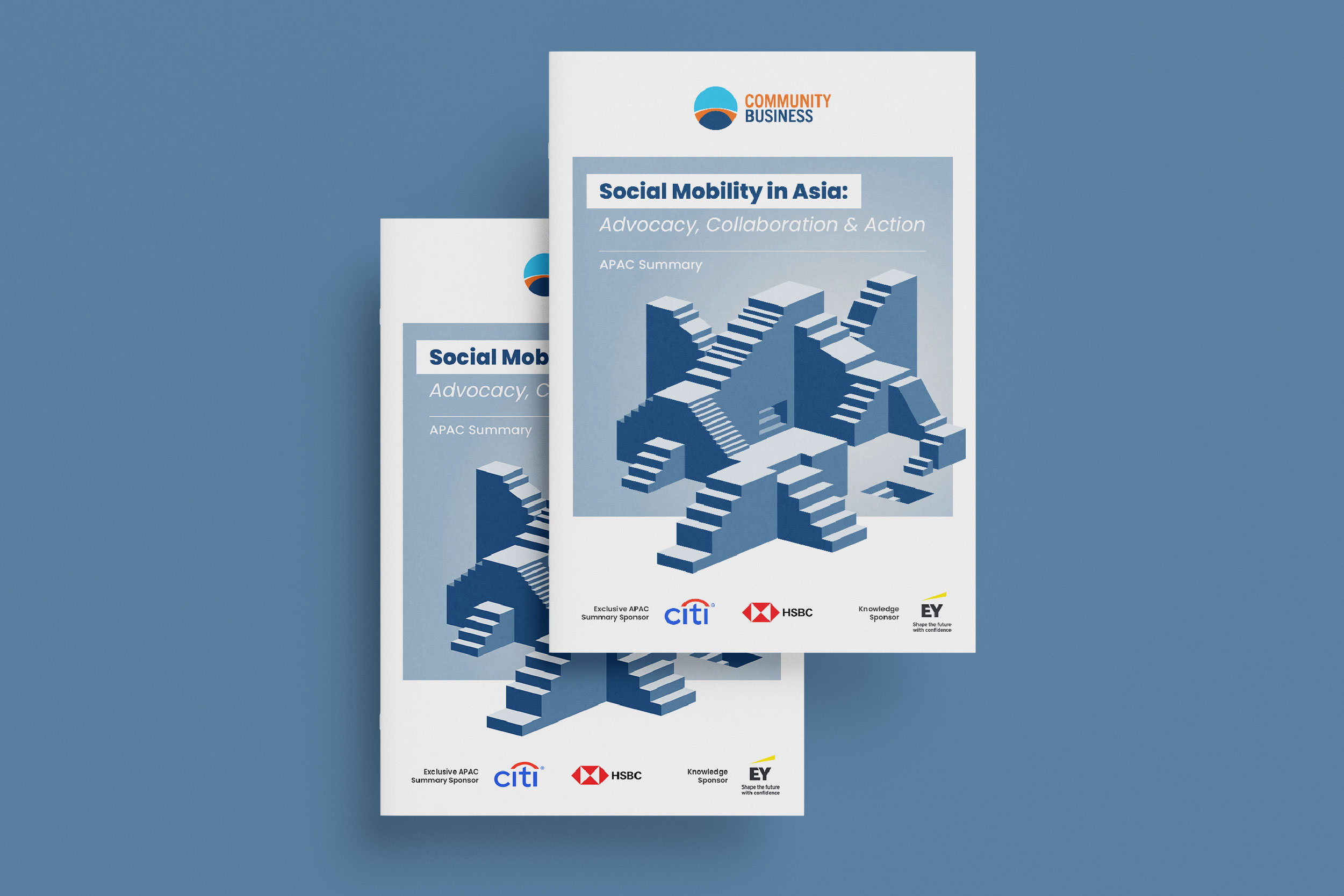
This report examines how social mobility impacts workplace equality in Asia, and how factors like opportunity, privilege and access shape an individual’s career progression. I designed the cover and full report layout, presenting complex insights in a clear and engaging way.
The cover illustration draws on the theme of a ladder to represent social mobility. The shifting stairs, varying in direction and size, highlight that everyone’s path looks different, with some routes more challenging than others. To improve readability in this text-heavy report, I adopted a two-column layout and used infographics to break up sections and guide readers through the content. A clear font hierarchy and consistent design patterns were applied throughout to help readers easily recognise recurring elements and navigate the report with ease. Charts and visualised key findings were incorporated to make complex data more accessible, allowing readers to quickly understand, compare and repurpose the insights.


Community Business, a non-profit promoting diversity, equity, and inclusion in Asia, refreshed its 20-year-old branding to better reflect its expanding networks. I led the logo, iconography, and social media rollout to establish a cohesive, modern identity.
The corporate font, Poppins, was too flat and wide to pair effectively with the circular logo. I tested multiple font options and ultimately selected Trade Gothic Next SP Pro Bold for its thickness and style, which complements the logo and conveys a professional, tidy vibe. The word 'Community' is in orange to symbolize the bridge element, representing connection and a sense of community, while 'Business' is in blue to project professionalism and match the foundation blue under the bridge in the logo.

The old CB branding lacked a monochrome version that could work effectively on colored backgrounds. Initially, we experimented with different monochrome styles, but the logo’s three-color design did not translate clearly. To solve this, I introduced a white circular frame around the logo, ensuring it remains legible and visually distinct when placed on any colored background.

A thick-line style was chosen to complement the logo, avoiding filled-color circles which could visually blend with the main logo. Over 140 custom icons were created to establish a consistent visual language across presentations and reports, supporting the brand without causing redundancy or clutter.

The brand colours were developed from the logo. Foundation blue became the primary colour for a professional, versatile base, while the bridge orange was kept as the secondary colour to retain familiarity from the old branding. Additional complementary blues were created to add depth and provide flexibility across applications.

Poppins is the organisation’s corporate font. Bold in blue is used for main titles to create strong, clear headers, while semi-bold in orange distinguishes subheaders. Light weight is used for body text, as Poppins runs slightly thicker than most sans-serifs, improving readability in longer paragraphs. This hierarchy ensures a smooth, intuitive reading flow.

To keep the logo looking sharp and consistent, a set of usage rules was defined. The mark should always be used with proper spacing, readable contrast and in the approved colour variations. Distortions, colour changes and placing the logo on overly complex backgrounds are avoided to maintain clarity and brand integrity across all touchpoints.

The final brand system was applied across key touchpoints, including the business card design, PPT templates and social media posts. These executions demonstrate how the visual identity functions consistently in real-world applications.


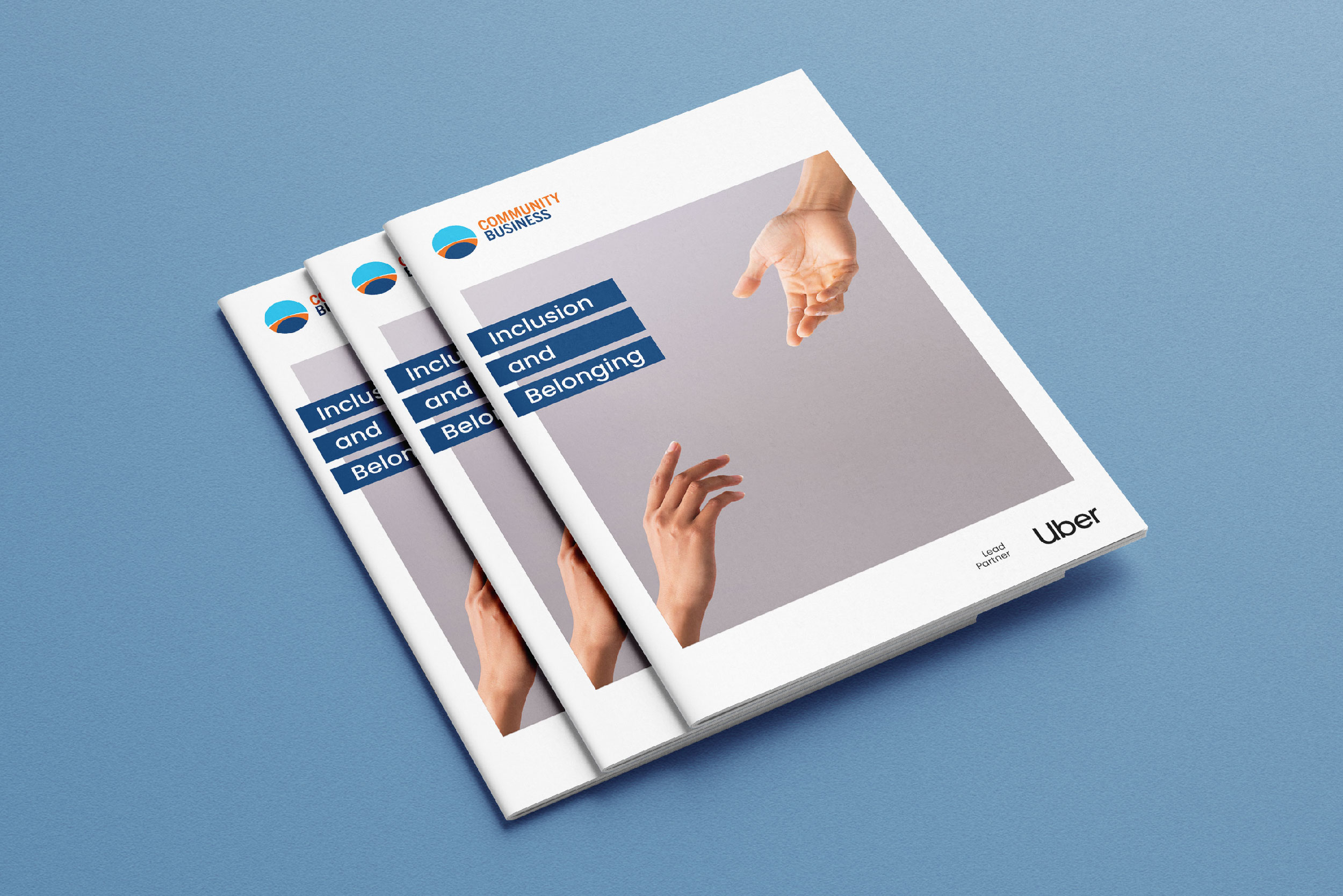
This research aims to explore how workplace inclusion has evolved and where companies most often fall short. My role was to design the report’s cover and layout, translating complex insights into a clear, engaging reading experience.
The cover features two hands reaching toward each other, a simple visual metaphor for 'Inclusion and Belonging', the core theme of this research project. The report contains dense text and complex findings. I focused on creating a structure that supports clarity and readability. I designed a 1:1 text layout to guide the reading flow, avoiding long, uninterrupted paragraphs that are difficult to track. Icons, graphic elements and infographics were used throughout to break up information and make data easier to digest. A clear font hierarchy further supports a smooth reading experience by distinguishing sections, highlights and key messages. Since Community Business and its partners often repurpose this content for training and presentations, I also designed visualised key findings, including charts, tables, and summary graphics, to help readers quickly understand the insights and easily reuse the material.


This landing page is a concept for a newly founded non-profit organisation that advocates for animal rights and aims to raise awareness about animal welfare issues. The purpose of the website is to serve as an online platform for Animal Advocates United to share their mission, goals and accomplishments with the public. The website is a hub for resources related to animal welfare, including educational materials, news articles and ways for the public to get involved and support the organisation.
The design for Animal Advocates United's website was to align with its mission of promoting animal welfare. The website was created with a user-centric approach, ensuring a seamless and engaging experience for visitors. I focused on creating a visually impactful homepage featuring a captivating hero image that immediately conveyed the organisation's purpose along with its mission statement. The layout was designed to guide users through the site, with clear navigation and prominent call-to-action buttons strategically placed throughout. The What We Do section showcased the organisation's key programs and services, captivating users with compelling imagery and concise descriptions, allowing them to easily navigate and explore the breadth of Animal Advocates United's work. The website also addressed the target audience's need to see results from the organisation’s work. By incorporating the Animals We Saved section, the site effectively communicated the organisation's impact and encouraged visitors to become active participants through donations or volunteering.

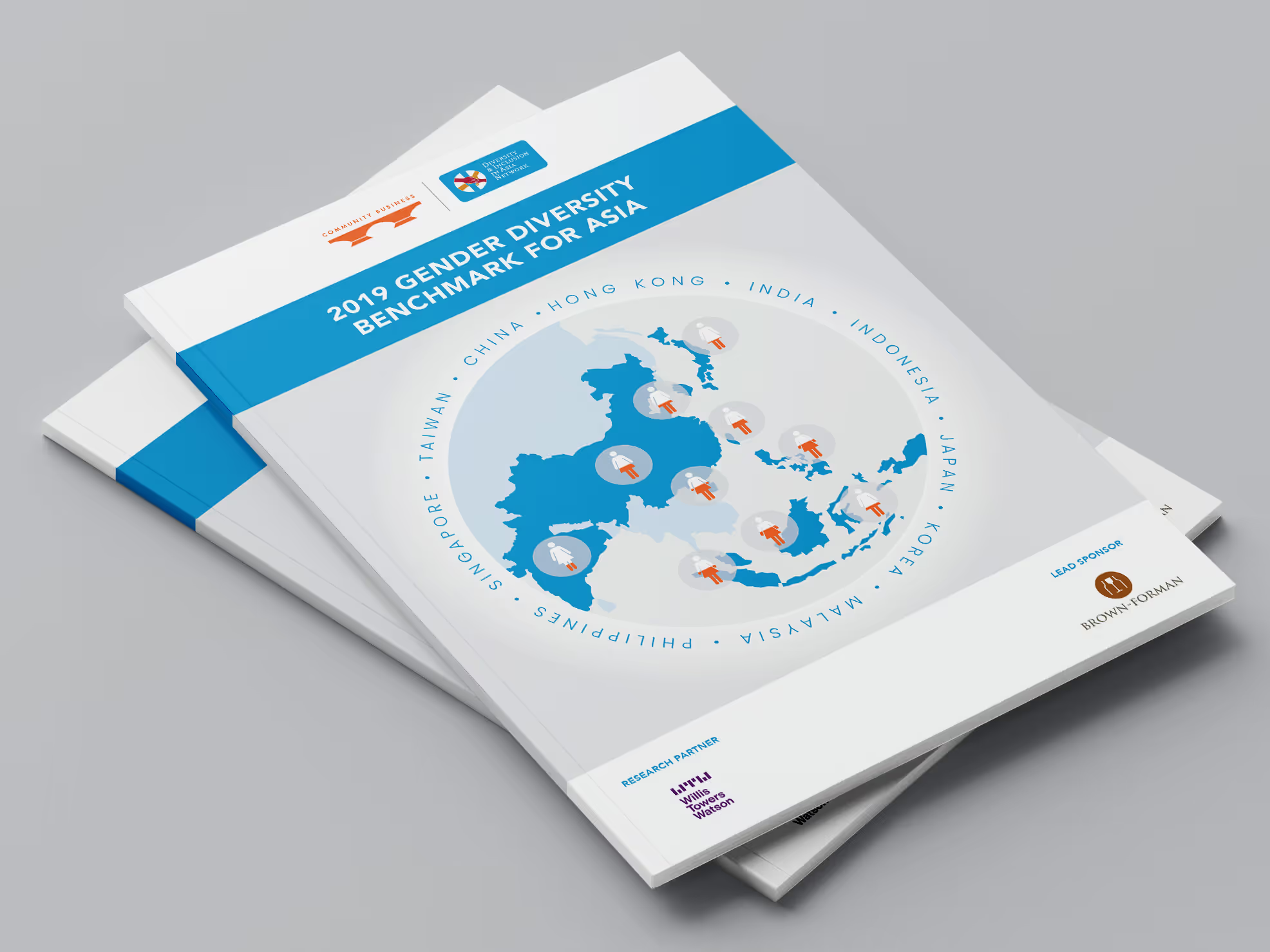
Community Business (CB) has been compiling its flagship study, the Gender Diversity Benchmark for Asia since 2009, with updates published in 2011 and 2014. Widely referenced, to date these studies have benchmarked the representation of women in multinational companies operating in Asia and specifically the markets of China, Hong Kong, India, Japan, Malaysia and Singapore.
The cover was designed to provide a succinct summary of the research undertaken and its key findings. The targeted markets increased from 6 in 2014 to 10 in 2019, a world map was used to display its climbing to a global scale. All graphics were created in a circular layout to match CB’s branding. The colour filled women icons were positioned in corresponding locations to reflect the ratios and rankings. To ease the readers' comprehension of the report, I introduced several visuals. For example, diagrams for data comparison allow readers to easily understand, process, and recognise emerging trends and patterns. Key findings in the tables were emphasised by the highlighted colour. Likewise, data visualisations were designed in a grid layout where CB and readers could easily abstract and repurpose the content for training and presentation. I built a consistent template with distinctive colours to differentiate the 10 markets. The first page used hue shading to draw readers’ attention from top to bottom, highlighting the ranking results. To enhance readability, I also applied a clear font hierarchy to indicate the reading flow throughout the publication.


On the International Day for Persons with Disabilities, Community Business (CB) launched a social media campaign to educate people on the complexities of disabilities and provide tips for navigating these conversations. I was asked to design 6 carousels, a total of 20 posts, that were posted on CB's social channels.
CB's aim was to educate its followers and subscribers about disabilities and for that knowledge to be shared and spread further, creating a ripple effect that would benefit the community. To visualise this idea, I used a world icon surrounded by circular lines and circles to represent the spreading effect. The background in each carousel was linked using the designed illustration, with an additional arrow icon in each post to indicate further slides. To grab the target audience's attention quickly, I employed a straightforward layout that emphasizes the central focus.

LGBT+ community uses a variety of terms to identify themselves, not all of which are familiar to businesses and allies, at times it can cause confusion and misunderstanding. Approaching Pride month, Community Business (CB) launched a social media campaign to assist people to understand LGBT+ terminology better. I was asked to design 24 Instagram posts for an LGBT+ glossary, from research to final production.
To ensure the posts would draw the attention of the groups CB was targeting (LGBT+ community, allies and businesses in Hong Kong). I created a background story that was brought to life by a series of colourful, eye-catching illustrations: 'A group of pink dolphins swim through the LGBT+ community to learn about different terms.' Pink dolphins found in the waters of Hong Kong often swim in pods, an apt representation of the community. Seeing pink dolphins in Hong Kong waters is a collective memory for locals and the reason I chose them for this project. Similarly, the waves used in the illustrations represented fluidity, an overarching concept in the LGBT+ community. To stay consistent with CB’s brand style, I represented each flag of the LGBT+ community as a circular icon and assigned them the colour they are most closely associated with. The posts were designed in a simple layout that connected horizontally across 3 posts. With the use of white space, each LGBT+ term was positioned as the focal point where readers could instantly see what the posts were about. Besides making the terms more prominent among other elements, the white waves allowed space for CB’s LGBT+ campaign logo, which was not permitted to be put on a colour background according to brand guidelines.

REGIONAL VERSION'The Pink Dolphins continue to swim through Asia to learn more about different regions’ localised LGBT+ terms.' The waves were changed into respective regions’ famous skyscrapers. The terms’ flags were changed to the regions’ flags.

Explorer Island is a language art centre for toddlers in Hong Kong. It launched a series of promotions for its 10th anniversary. In this significant milestone, the centre wanted to introduce a dinosaur to accompany its existing character the Explorer, increasing its brand image to stand out among other centres and be memorable to the targeted customers. As a freelancer, I was asked to design the dinosaur character and 10 leaflets within the centre’s brand style for advertising.
The dinosaur was designed to be flexible and adaptable to scenarios by adding other graphic elements. In this way, the centre could continue using the character in future to build and improve its brand image with consistency. The layout across 10 leaflets was consistent and cohesive. The titles were designed in a bold and colourful style with typography and visual graphics to add playfulness. The dinosaur and discount offers (50% off, buy one get one free) were positioned as the most prominent elements in the layout where viewers could instantly notice the deals at first glance. I used tables and font hierarchy to simplify the offer details, ensuring the content was clear and understandable.


Meinhardt is a leading global planning, engineering and project management company. With offices in the country’s top administrative and business cities – Beijing, Shanghai, Hong Kong and Shenzhen – they are right in the heart of rapid infrastructure and urban developments. Its logo is recognised across the globe and represented its unique standpoint and strategy in the industry.
This concept for Meinhardt's Hong Kong branch is designed to reinforce its corporate identity across all media and platforms using the existing logo. Two main components of the logo are the red square and its tilted font at a certain angle. The altered font symbolised rulers and measurement. I have created an illustration showcasing several of Hong Kong's most notable skyscrapers that Meinhardt had worked on. To visualise the concept, I have created a compilation of branding assets.


Meinhardt Hong Kong is an engineering consultancy company. Its office in Hong Kong has over 1,000 staff. Below is a series of promotional posters I created throughout my time there as an in-house designer. I specifically selected a few to showcase my ability to visualise the information creatively using typography and composition.


Luci Di Gala is a supplier that provides top-quality craftsmanship of jewellery. To engage potential clients and increase brand awareness, I was asked to design 23 unique and characteristic displays for their booths in the Hong Kong Jewellery & Gems Fair 2017, the world's premier trading hub for jewellery. All illustrative displays were created in a mandala-inspired hand-drawing style, using repetition to create impactful visuals, to conceptualise and visualise each collection's unique traits.